The Real AI Revolution Isn't Automation. It's the Death of Scarcity Economics
What Would You Build If Labor Cost Almost Nothing?
I was in a room with corporate executives last week, talking about AI and the future of work.
Everyone had the usual talking points ready: automation, efficiency, unlocking unstructured data, faster decision-making.
I realized we were all missing the plot.
We've Seen This Movie Before
Remember when smartphones first appeared? They were expensive. Limited. Most people couldn't justify the cost for a device that basically did email and texting.
The skeptics had reasonable arguments. "Why would I pay this much for something my laptop already does?"
Fast forward two decades. Your grandmother has a smartphone. So does every teenager in the developing world. The device that seemed like a luxury became infrastructure.
The same pattern played out with mobile data. Remember when carriers sold "unlimited WhatsApp" packages because actual unlimited data was too expensive? When you'd anxiously toggle between WiFi and 3G to save your monthly allocation?
Now most of us pay roughly the cost of a Netflix subscription for more data than we can use.
This is exactly where we are with AI right now.
We're in the "carefully managing mobile data" phase. Watching our API costs. Debating whether this task justifies the tokens. Treating AI like a scarce resource to be rationed.
But the trajectory is clear. AI will become so cheap, so fast, so ubiquitous that it will be embedded in every workflow, every tech stack, every process.
Which brings me to the question that should keep every business leader up at night:
What Would You Do Differently If Labor Was Essentially Free?
Not "what would AI automate for you"—that's thinking too small.
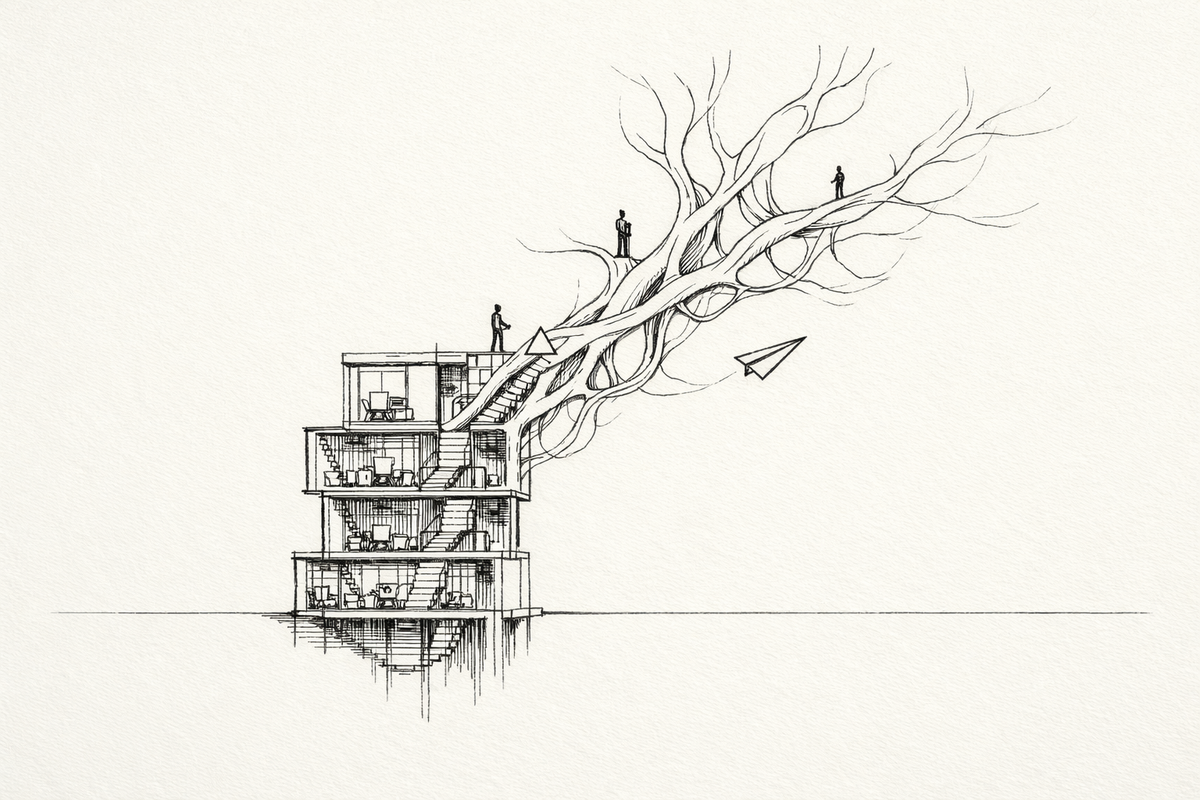
The real question is: How much of what you do today exists because labor is expensive and limited?
Think about your processes. Your forms. Your approval chains. Your checks and balances. How much of that architecture assumes that human attention is a bottleneck?
Let me make this concrete.
The GitHub Example
When developers work on a shared codebase, they use Pull Requests. Developer B writes some code, submits it with an explanation, and Developer A reviews it before approving.
This seems like natural workflow. It's actually a bottleneck we've normalized.
We bolt on automated checks—code quality scanners, formatting validators—but the core process remains human-limited. Why? Because pushing code to production is risky. If Developer B's change breaks Netflix, millions of dollars evaporate every minute.
So we created Canary releases: push the new version to 1% of users first. See if anything explodes. If it does, roll back.
Smart solution. But here's what bothers me: which 1% of your users are you volunteering as lab rats?
Now imagine this: What if you could test every release with unlimited testers who cost almost nothing?
Not automated test scripts—actual intelligent agents who can navigate your app like a user would. Who understand responsive design, can read documentation, can check if that button has the right transparency level according to your design system.
That tester exists today. Major AI providers can simulate end-user behavior on web applications right now.
The AI "employee" doesn't need HR onboarding. No background checks. No six-month ramp-up to understand your documentation and design systems. No wondering if they'll fit the company culture.
Expand This to Everything
Take what I just described for QA testing and apply it across your entire organization.
HR. Finance. Security. Strategy. Executive decision support.
What happens when every department has access to unlimited, capable workers at near-zero marginal cost?
I'll tell you what I'd do: I'd release new features constantly.
Why wouldn't you ship all the time if you have unlimited testers? Your Canary release becomes AI users first, then AI mixed with a small percentage of humans, then broader rollout. Your actual customers never have to be guinea pigs again.
The HR Thought Experiment
Here's one that makes people uncomfortable.
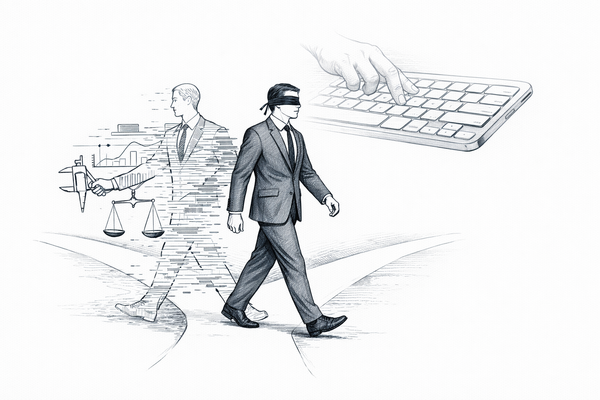
Why do we have standardized HR policies? Because not everyone performs the same. Not everyone has the same accountability. So HR creates one-size-fits-all rules to manage the variance.
Everyone gets 15 vacation days because we can't actually measure individual contribution at scale.
But what if you could?
An AI that observes work output—not surveillance for surveillance's sake, but genuine performance measurement—could enable genuinely individualized policies. Vacation days calibrated to actual output. Compensation tied to real contribution.
(Yes, this raises privacy questions. But let's be honest: there's no privacy in corporate work already. If your company is run properly, you're on corporate hardware, corporate network. Everything is monitored. The question isn't whether to measure—it's whether to measure intelligently.)
The Real Shift
Here's what I wish those executives understood:
"AI automates tasks" is a footnote.
"AI unlocks unstructured data" is a footnote.
"AI helps with decision-making" is a footnote.
These are all subsets of the actual transformation: the cost of cognitive labor is trending toward zero.
Every process you've designed, every policy you've written, every organizational structure you've built—they all encode an assumption that human attention is expensive and finite.
That assumption is becoming obsolete.
The Question That Matters
I'm not talking about some theoretical future. I'm talking about capabilities available today.
So here's what I want you to sit with:
How much of what your company does exists because labor was expensive? And what would you build differently if it wasn't?
The companies that figure this out first won't just be more efficient.
They'll be playing an entirely different game.